Tempest in a Stockpot
Tempest in a Stock Pot is a 12-episode podcast on Smithers Community Radio CICK 93.9FM focusing on food security in northern BC. It features conversations with food producers, academics, researchers, and community leaders to highlight inequities, raise awareness of challenges, potential solutions, inspire grassroots change, provoke reflection, and ultimately influence local and provincial action.
When the food system we want to eat from seems impossible to reach, there is hope in the actions people are taking. Across northern BC, people are impacting different parts of the system and making today better while also creating the elements for a future food system that will be delicious and just.
-
https://www.smithersradio.com/program-playlist/tempest-playlist-smallmammals-04082026
In this opening episode, Dr. Theresa Healy and Jordan Bultitude explore the fundamental pillars of food security and the essential role of equity in the right to food. Discover how different experiences and perspectives illustrate our collective responsibility and how even the smallest factors can significantly impact community well-being.
Resources & Links:
Public Health Association of BC - https://phabc.org/cfsd/
Right to Food Canada - https://righttofood.ca/Land acknowledgement: North American beaver
Music: Royal Coupling by Kevin MacLeod -
https://www.smithersradio.com/program-playlist/tempest-playlist-foodpolitical-04152026
In this episode, Dr. Daniel Sims of the University of Northern British Columbia and the Tsay Keh Dene First Nation provides a powerful look at food justice through an Indigenous lens. Set against the backdrop of Prince George, the conversation explores how colonization shifted traditional views of food and the vital role of First Nations governance in reclaiming food sovereignty today.
Resources & Links:
Dr. Daniel Sims - https://www.unbc.ca/people/sims-dr-daniel
Land acknowledgement: moose
Music: Firesong by Kevin MacLeod -
https://www.smithersradio.com/program-playlist/tempest-playlist-weaponizingfood-04222026
Dr. Ian Mosby, a historian of food, Indigenous health, and settler colonialism at Toronto Metropolitan University, provides a sobering historical tour of the Canadian landscape. His analysis examines how colonial programming was systematically used as a tool to dismantle Indigenous power and erode the cultural significance of traditional food systems. Then Sik-e-Dakh’s Growcer Business Manager, Charlie Moraes, and Farm Manager, Clifford Capezzuto, take us on a tour of the community's food security project. Their work highlights how Gitxsan people are actively claiming their agency and replanting the seeds of community self-sufficiency through sustainable local agriculture.
Resources & Links
UBI Works - https://www.ubiworks.ca/
Dr. Ian Mosby - https://www.torontomu.ca/history/about-us/faculty-and-staff/faculty/mosby-ian/
Sik-E-Dakh - https://www.glenvowell.ca/
Land acknowledgement: eagle
Music: Twisting by Kevin MacLeod -
https://www.smithersradio.com/program-playlist/tempest-playlist-gatewaydrug-04292026
In this episode, farmer, biologist, and organic consultant Jolene Swain joins the conversation from Kispiox to explore the vital question: Can we truly be self-sufficient in the North? The discussion aims to inspire local self-reliance while providing a deeper understanding of how the modern food system is often structurally "stacked against us."
Resources & Links:
Short Season Seeds - https://woodgrain.ca/seeds/
Pollan, Michael (2001). The Botany of Desire: A Plant's-Eye View of the World. The Random House Publishing Group.
Land acknowledgement: fireweed
Music: Foxtail Waltz, part 1 by Kevin MacLeod -
https://www.smithersradio.com/program-playlist/tempest-playlist-raisinghope-05062026
Hélène Fleury from the Groundbreakers Agriculture Association joins the conversation from Smithers to discuss the future of food security. The episode explores the concept of training the next generation to be "competent eaters"—encouraging youth to stay aware of their own body's needs while understanding the practicalities of what is available in their environment. By bringing younger voices into the fold, the series aims to build a pragmatic and well-informed hope for tomorrow.
Resources & Links:
Bulkley Valley Groundbreakers - https://www.bvgroundbreakers.ca/
The Coalition for Healthy School Food BC - https://www.healthyschoolfood.ca/bc-chapter
Farm to School BC - https://farmtoschoolbc.ca/
Land acknowledgement: pine marten
Music: Fuzzball Parade by Kevin MacLeod -
https://www.smithersradio.com/program-playlist/tempest-playlist-challengingcharitymodel-05132026
In this episode, Jordan Bultitude of Gordon Neighbourhood House and Right to Food critiques the inequities inherent in traditional charity-based food systems. From their base in Vancouver, they discuss the push for a Universal Basic Income (UBI) as a transformative tool to restore dignity and agency to food security across Canada.
Resources & Links:
UBI Works - https://www.ubiworks.ca/
Right to Food response to Federal Canada Budget 2025 https://righttofood.ca/briefing-note-key-food-security-measures-in-federal-budget-2025
Land acknowledgement: boreal forest
Music: Crusade - Heavy Industry by Kevin MacLeod
-
https://www.smithersradio.com/program-playlist/tempest-playlist-mappingfoodjustice-05202026
This episode explores initiatives to bridge the gap between fresh food availability and community access.
First we visit Prince Rupert with Dianne Villeseche, Community Food Systems Programme Manager with Ecotrust Canada and Alaina Pyde, Project Developer with TBuck Suzuki Environmental Foundation to highlight efforts in Prince Rupert schools to provide more local, culturally acceptable foods despite barriers in sourcing local seafoods.
Then Peter Leblanc talks to us about the BC Farmers’ Market Nutrition Coupon Program as ‘made in BC solution’ to build bridges between locally grown foods and lower-income households.
Resources & Links:
TBuck Suzucki Foundation - https://www.bucksuzuki.org/
Ecotrust North Coast Food Hub - https://ecotrust.ca/latest/blog/sharing-the-harvest-dianne-and-the-north-coast-food-hub/
Nadia Halward is the SD52 Food Coordinator in Prince Rupert and a key partner in the North Coast Food Hub and is lead on the Ideas Lab project Salmon in Schools. Her email is Nadia.Halward@sd52.bc.ca.
BC Farmers’ Market Coupon Program - https://bcfarmersmarket.org/coupon-program/
Gastropod episode exploring USA food stamp program https://gastropod.com/snap-to-it-why-food-stamps-matter-to-all-of-us-and-why-theyre-under-threat/
Land acknowledgement: salmon
Music: Aquarium by Kevin MacLeod -
https://www.smithersradio.com/program-playlist/tempest-playlist-lessoninclusion-05272026
Featuring Angie Gagnon, the Food Security Coordinator for Witset, this episode explores the fundamental question of "Who do we shelter?". It addresses the concerning trend of non-inclusion often found within food security systems to advocate for a more welcoming approach. Additionally, the episode honours the legacy of Lesley Jackson, a Smithers farmer recognized for her quiet but significant impact on attracting youth and fresh perspectives to the region.
Resources & Links:
Witset Community Garden - https://www.facebook.com/p/Witset-Community-Garden-61565831123942/
Land acknowledgement: mountains
Music: Evening by Kevin MacLeod -
https://www.smithersradio.com/program-playlist/tempest-playlist-communitynotcommodity-06032026
This episode explores the intersection of racism, capitalism, and food access. Conversations with Jacob Beaton of Tea Creek Farm, Jonathan Knight of Woodgrain Farm, and Hannah Stockner from Kispiox Lodge highlights how northern farmers strive to make equal food access a fundamental way of life despite systemic challenges.
Resources & Links:
Tea Creek - https://www.teacreek.ca/
Indigenous Food Sovereignty Association - https://www.ifsovereignty.ca/
Woodgrain Farm - https://woodgrain.ca/
Kispiox River Lodge - https://kispioxriverlodge.ca/
Aronson, Louise (2019). Elderhood: redefining aging, transforming medicine, reimagining life. Bloomsbury Publishing.
Land acknowledgement: soapberry
Music: Magic Scout by Kevin MacLeod -
https://www.smithersradio.com/program-playlist/tempest-playlist-hopethroughaction-06102026
This episode explores the practical realities of food sovereignty through the work of Laurie Gallant and MASH (Making Agriculture Sustainable in the Hazeltons), who are addressing the loss of local poultry slaughter facilities, and Cameron Bell, owner of Farmer Cam’s Foods, who shares his determination to attract more youth to farming. It examines how individuals are actively working around challenges created by bureaucratic thinking and government regulations that often fail to account for northern contexts. Ultimately, the episode highlights how local action can overcome systemic obstacles to build a more resilient and self-sufficient food system.
Resources & Links:
Making Agriculture Sustainable in the Hazeltons https://mashazeltons.org/
MeatUHere - https://meatuhere.ca/Farmer Cam’s Foods - https://www.farmercamsfoods.ca/
Land acknowledgement: rocky soil
Music: Krampus’ Workshop by Kevin MacLeod -
https://www.smithersradio.com/program-playlist/tempest-playlist-manufacturedpoverty-06172026
This episode features Claire Dewar and Krystle tenBrink from the Squamish region, who discuss how their community explicitly counteracts the stigma inherent in capitalist food systems. By working directly with politicians to reform food policies, they demonstrate that giving people agency over their food choices transforms community interactions and social equity. The discussion highlights how overcoming stigmatizing attitudes is a crucial step in ensuring true food security for everyone who needs to eat.
Resources & Links
Squamish Food Policy Council - https://www.squamishcan.net/food-policy-council
Land acknowledgement: water
Music: Heavy Industrial by Kevin MacLeod -
https://www.smithersradio.com/program-playlist/tempest-playlist-appleofyoureye-06242026
In the series finale, Dr. Colin Dring, Senior Researcher at Royal Roads University, provides an analytical framework for understanding the alternative food systems and decolonizing practices discovered through their action research in the recent years.
The episode serves as a celebration of the sustainable and equitable local practices found in the north that offer a path toward more resilient food systems. It concludes with an invitation for listeners to take their own next steps, emphasizing that meaningful change happens through relationships and collective action at any scale.Resources & Links:
Dring, C. C., Lin, S., Newell, R., Dower, R., MacLachlan, E., James, D., & Robin, T. (2025). Possibilities for decolonizing food planning: Addressing ontological dominance, affective and relational dispositions, and (re)imagining just food futures. Possibility Studies & Society, 27538699251324727. https://doi.org/10.1177/27538699251324727
Smith-Carrier, Tracy. (2025, October 14). Canada's poverty and food insecurity have deep structural origins. The Conversation. - https://theconversation.com/canadas-rising-poverty-and-food-insecurity-have-deep-structural-origins-265570
Digesting Food Studies Podcast - https://canadianfoodstudies.uwaterloo.ca/index.php/cfs/podcast
Land acknowledgement: precipitation
Music: Crossing the Divide by Kevin MacLeod
Theme music by Elijah Larsen at Soniquinn Studios. https://www.soniquinnstudios.com/
ALSO Streaming on Spotify!
Comments, questions, and feedback can be sent to info@storytellerssociety.org
Brenda Barritt, Executive Director of Storytellers’, is a settler of central European ancestry whose family has lived in Canada for several generations. Now based in northern British Columbia, she brings both lived experience and a strong sense of place to her work in community development and learning. Much of her work focuses on food security and food sovereignty, approached through a relational lens that recognizes food as more than sustenance. She often draws on the idea from Patti Digh that “the shortest distance between two people is a story,” adding that food is a close second—both serving as powerful ways to connect, nourish, and build community. Through this perspective, Brenda supports initiatives that weave together individual and collective stories, strengthening relationships and a shared sense of belonging.
Over the past 15 years, Brenda has been deeply involved in food systems work across Canada, including a decade as a farmer providing locally raised protein directly to households. This hands-on experience continues to inform her understanding of sustainable, community-based food systems. In addition to her professional work, Brenda is a mother and an elected member of local government. These roles ground her approach, shaping the curiosity, care, and commitment she brings to her work and to the communities she serves. You can reach her at brenda@storytellerssociety.org
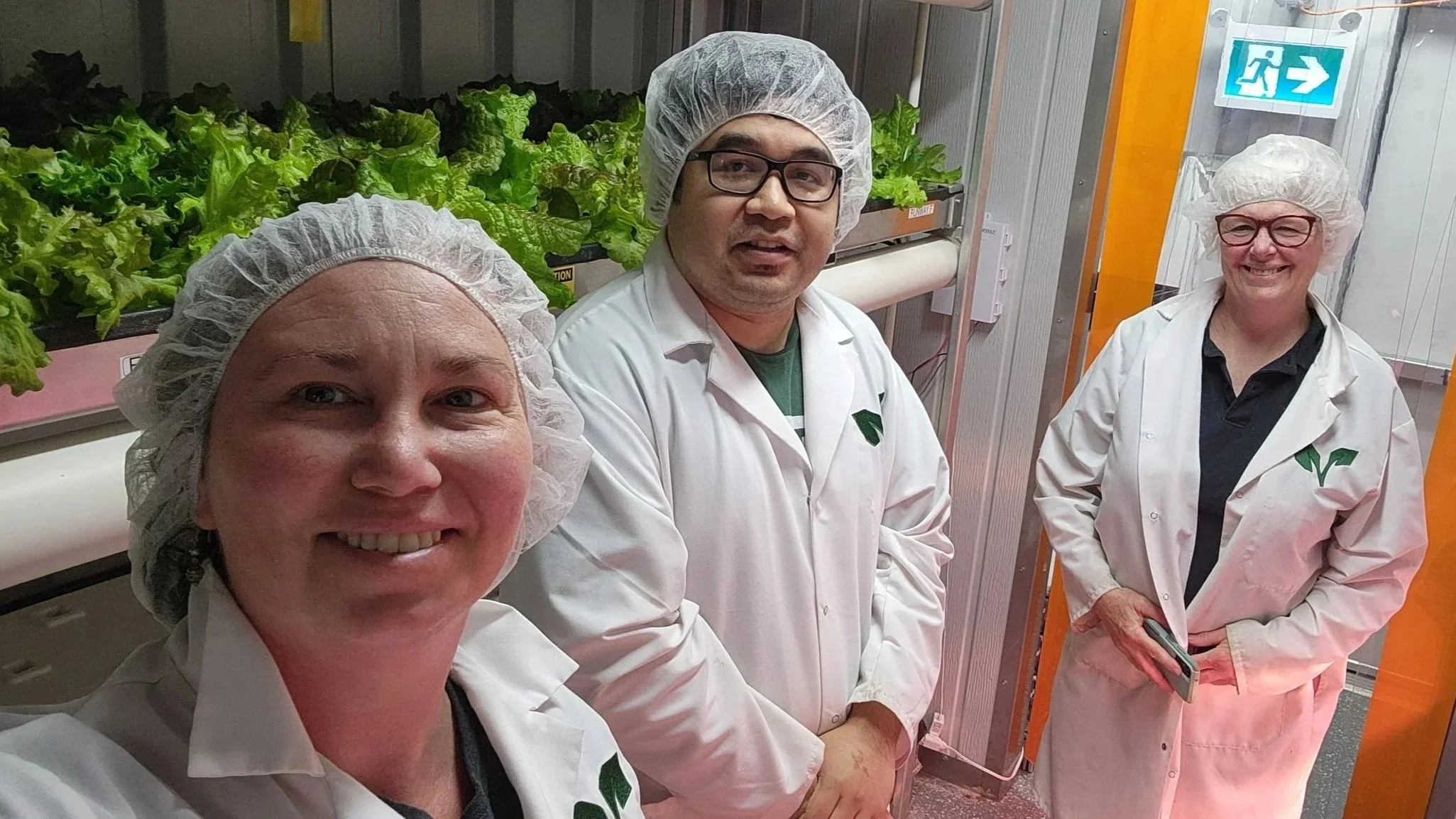
Brenda & Christine with Charlie inside Sik-E-Dakh’s Growcer unit.
Christine Bruce brings a rich and multifaceted background that blends technical expertise, community advocacy, and a deep commitment to health, environment, and food systems. She began her career as a professional technical writer in Toronto’s software industry, building a strong foundation in clear communication and knowledge translation. In more recent years, her advocacy-focused podcasts through CICK have earned multiple awards, reflecting both her skill and dedication to community storytelling and engagement.
A lifelong volunteer, Christine has been widely recognized for her work in animal rights, housing precarity, and food security. Advocacy has been a constant thread throughout her professional and personal life, guided by core values of compassion and environmental stewardship. Her perspective is further shaped by her background as a certified personal trainer with expertise in nutrition, bringing a health and wellness lens to her work in food systems. Christine is especially passionate about the relationships built through food and the importance of supporting local producers. She actively encourages community members to buy and eat locally, seeing this as essential to both individual well-being and broader environmental and economic resilience. You can reach Christine at rusticscribe@gmail.com
Tempest in a Stock Pot was funded through the Ideas Lab for Food Systems Transformation, an initiative strengthening food security across northern BC by supporting collaboration, innovation, and more resilient local food systems. This initiative was made possible with funding from the Ministry of Social Development and Poverty Reduction and facilitation from the Public Health Association of British Columbia and Food Banks BC.
For more information on this initiative and others being supported through the partnership, visit https://phabc.org/cfsd/ or www.CFSD-PHABC.ca
The Smithers Community Radio Society is an incorporated non-profit that manages a locally supported, volunteer operated community radio station (93.9FM). Broadcasting from the historic Central Park Train Car, our programming focuses on local artists, non-mainstream Canadian music, and commentary reflecting the community's diverse perspectives.
Find out more about CICK and their programming at https://www.smithersradio.com/